
Flower Artists and Their Wonderful Connection To Nature

Updated: Mar 26

Flower Artists - Kindred Spirits
When I sit down to create my art, often after a soothing stroll through the lush landscape that surrounds my home in Wales, I feel part of something greater. Nature always has a way of healing me, grounding me, inspiring me, and reminding me that art is not about capturing perfection but about honouring life’s fleeting beauty. And, I do not think I am alone. I often feel a kinship with flower artists of the past and present.
Some of the greatest painters turned to flowers and landscapes not only as subject matter but also as a mirror of their own emotions. I'm convinced that their brushstrokes echo the same wonderful connection to nature that I feel in my work at Minnie La La Designs. Their words, their memoirs, even the way they described light and colour, everything suggests that their artistry bloomed when connected with the natural world.
Below, I’ve gathered some of the flower artists who speak most to my heart. Arranged alphabetically, they remind me that across time and styles, the language of nature is universal.
Gauguin
Paul Gauguin, like the other flower artists you will encounter in this blog, is not solely known for his depictions of flowers. However, it is my observations of his work and his connection to nature that I wish to highlight in this blog.
Gauguin always strived for something beyond the ordinary. Whilst initially he was schooled in impressionism, he went on to pioneer a whole new movement of art, symbolism. I believe his move to Tahiti in the 1890s was not just a relocation, but an escape, away from the confines of European society. The move took him toward a wilder, more natural environment where flowers and foliage felt freer.
What I admire most about Gauguin as a flower artist is that his floral pieces aren’t gentle imitations of reality; they are bold in colour, dreamlike, and sometimes almost surreal. The bright blooms and jungle greens in his Tahiti paintings, post-impressionism (which include many landscapes, another of my passions), seem to flow with life, as if he were painting not just what he saw but what he felt.


Gauguin’s yearning to connect with the world around him resonates with me. When I paint a piece of art, I do not strive to capture botanical accuracy. Instead, I want to express the joy I feel when I see fabulous flowers nodding in the warm Welsh summer breeze. Gauguin once said, “I shut my eyes in order to see.” For me, he perfectly describes how landscape and flower artists work, not by looking harder but by feeling deeper.
Klimt
Gustav Klimt is often associated with shimmering gold, intricate patterns, and female figures wrapped in rich fabrics and ornaments. But if you look at his landscapes, especially his flower gardens, you see another side of him, one equally obsessed with nature. He painted these whilst on his summer holidays, as 'Doing nothing gets boring after a bit', taken from a letter he wrote to his mistress.
As one of my selected flower artists, Klimt’s canvases of dense wildflowers and buildings nestled in nature show a complete feeling of freedom, compared with his 'Gold Phase' paintings. What I love is the sheer abundance of his gardens, every inch filled with something alive. Klimt’s floral paintings feel less like landscapes and more like immersive experiences, as if you could step into them and be enveloped in petals.


This is exactly how I feel when I walk through the countryside near my home. My senses are overwhelmed, but in the best possible way. Klimt once declared, “Art is a line around your thoughts.” I think his flower paintings show how his thoughts circled around the intense beauty of nature, containing it just enough to share with us. My own work as a flower artist often tries to do the same: to capture nature’s energy without diminishing it.
If you would like to read more about Klimt, please click the link.
Mary Cassatt

Mary Cassatt is the only American to exhibit with the Impressionists in Paris. Whilst she is predominantly celebrated for her portraits of mothers and children, I love the influence nature had on her compositions. There’s a quiet thread of flowers running through her work. Often, particularly in her earlier work, her subjects are sitting in a garden or landscape. Likewise, many of her sitters are painted wearing floral fabrics or bonnets decorated with flowers.

What I love about Cassatt, as an unlikely flower artist, is how she used them as symbols of tenderness. Flowers in her art are not just decoration; they strengthen the feminine themes of nurture and love. I love to reflect this, at times, in my own creations as a flower artist, expressing the true healing power and love that you can experience from Mother Nature herself.
Monet
Claude Monet may be the ultimate flower artist. His gardens at Giverny weren’t just places to relax; they were his muses. In fact, his most famous series, the water lilies, sprang directly from the pond he built outside his home.
What I love about Monet is how he painted not just flowers and landscapes, but the light around them. He loved to capture reflections, shadows, and the way colours shift throughout the day and the seasons. I love doing the same thing, capturing the flowers and landscapes of the Welsh countryside surrounding my home at different times, in different seasons, because no two days are the same.


He once wrote, “I perhaps owe having become a painter to flowers.” That confession resonates deeply with me, because flowers are not just subjects in my art, they are friends and guides. Flowers and nature in general have healing qualities, something I believe all flower artists can relate to.
When I create, I think of Monet’s dedication to observing the same subjects, like the water lilies, never tiring of them. That’s what nature does: it teaches us that no bloom or landscape is ever the same twice, thanks to the power of Mother Nature. Each is unique and fleeting, ours to capture in memory. This is the gift of flower artists, to preserve the passing memory in strokes of colour and a celebration of the natural world.
Renoir
Pierre-Auguste Renoir’s paintings are bursting with warmth, and flowers often make an appearance. Discover them spilling out of a vase, decorating a bonnet, or framing a landscape. I particularly love the painting Renoir created that captures Monet as he stands, painting his own garden (see below). To me, it celebrates both artists' love of painting and their deep connection to nature.
His blossoms feel joyful and full of life, the same feelings I love to convey in my 'happy art' pieces. Renoir himself said, “Why shouldn’t art be pretty? There are enough unpleasant things in the world.” I couldn't agree more. To me, it's his pieces as a landscape and flower artist that provide the escape art offers to those participating in its creation and those viewing it.


I truly share Renoir’s sense of delight. My own work usually begins in joy, the simple joy I feel from being in nature. I believe this is an emotion that each of these flower artists shares.
Please, click here for more information about Renoir.
Van Gogh
Vincent van Gogh might be the most iconic of the flower artists. His sunflower series is instantly recognisable, not just for its brilliance of colour but for its intensity of emotion.
Van Gogh's early work centred on the peasant people and industry of his homeland; they are often quite dark, bleak creations. It isn't until around 1886 that you see his love of flowers starting to emerge. In contrast to his earlier work, they are full of life and colour; perhaps reflecting his move to the more vibrant city of Paris. His short brushstrokes give life and energy to flowers, just as nature provides me with life and energy. He once wrote, “If you truly love nature, you will find beauty everywhere.” Do you know that quote could easily be the motto of my own practice as a flower artist?

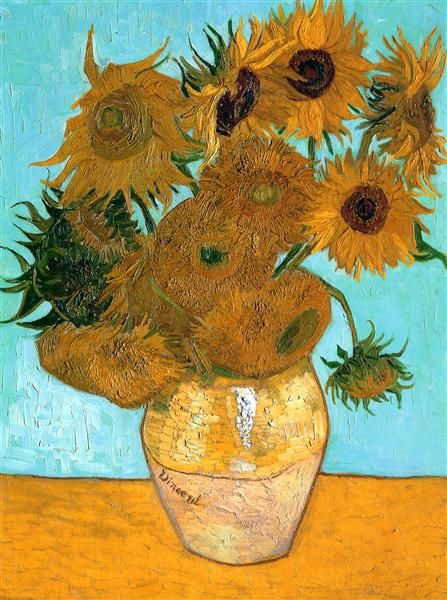
What I love most about Van Gogh is his honesty. His flowers are not idealised. They are free and alive with colour, yet he still includes the ones that are starting to decay, too. After all, even a torn petal, or a fading bloom, tells a story.
I suppose Van Gogh has been one of my biggest inspirations among all the flower artists, and it is his quote that keeps me connected to his work. 'Try to walk as much as you can, and keep your love for nature, for that is the true way to learn to understand art more and more. Painters understand nature and love her and teach us to see her. If one really loves nature, one can find beauty everywhere.'
If you would like to learn more about Van Gogh, click the link.
Yayoi Kusama
Not all flower artists are figures of the past. Yayoi Kusama, one of the most celebrated contemporary artists, brings a bold and unforgettable vision to flowers. Known for her dazzling use of polka dots, mirrored rooms, and vibrant sculptures, Kusama often turns to flowers as symbols of both beauty and infinity.
Her giant flower installations are not delicate imitations of nature; they are powerful, immersive experiences. Kusama once said, “I am just another dot in the world.” That humility, paired with her visionary style, makes her one of the most fascinating flower artists working today.
What inspires me about Kusama is how she reimagines flowers on such a monumental scale. A daisy or tulip in her work becomes larger than life, reminding us that nature’s forms are endlessly powerful and worthy of awe. In her hands, flowers become both playful and profound.


When I create at Minnie La La Designs (please, visit my gallery here), I often think of Kusama’s ability to take something small and transform it into an entire universe. That, to me, is the gift of flower artists: to reveal how each bloom contains both simplicity and infinity.
Please visit Yayoi Kusama's website here for more information.
A Shared Thread of Connection
Looking across these flower artists, from Gauguin’s exotic visions to Cassatt’s tender bouquets, from Monet’s endless lilies to Van Gogh’s fiery sunflowers, I see a common thread: a profound connection to nature as muse, guide, and mirror.
When I create my paintings, I feel like part of this lineage. My flowers are not just designs; they are conversations with the same forces that spoke to these painters. Each bloom I create, each landscape I form, carries the same wonder they found in their gardens, fields, and vases.
Flower artists remind us to pause, to breathe, and to see beauty in what might otherwise be fleeting. And that, I think, is the most wonderful connection of all.
If you would like to experience the same joy and connection with nature that I and other flower artists through the centuries have felt, then why not book onto one of my well-being workshops? No experience is necessary. After all, in the words of Van Gogh, 'What would life be if we had no courage to attempt anything?''


Comments